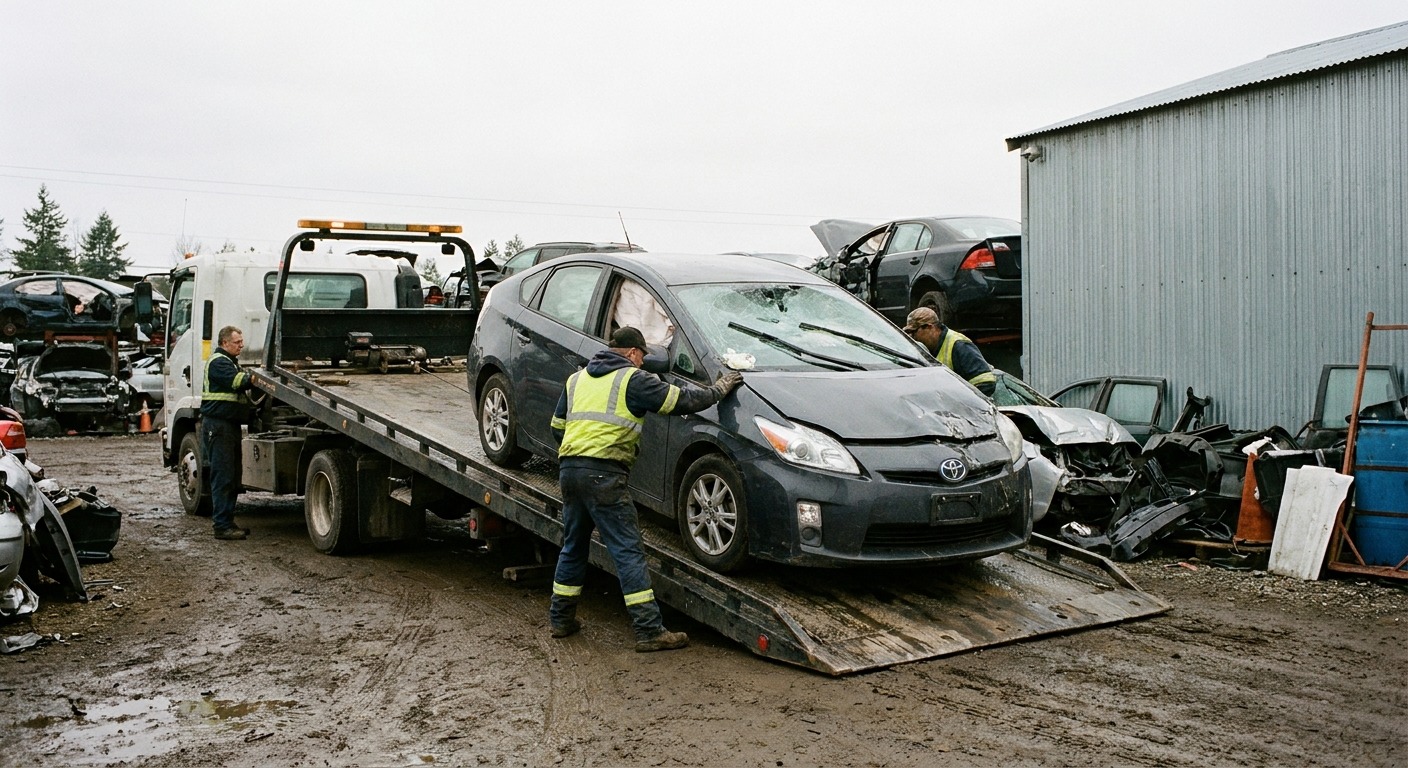
Most people's understanding of what happens to a wrecked car stops at "it goes to the junkyard." That is roughly as accurate as saying food "goes to the kitchen." The reality is a multi-stage industrial process with environmental regulations at every step, hazardous material handling that would make your municipal recycling depot sweat, and a recovery rate that puts blue-bin programs to shame.
I spent time at several Ontario and Quebec facilities watching this happen. Here is what the process actually looks like, from the moment a vehicle arrives to the moment its last molecule gets accounted for.
Step 1: Arrival and Assessment
A wrecked vehicle arrives at a licensed auto recycling facility by tow truck, flatbed, or occasionally driven in by its last owner. The first thing that happens is documentation. The Vehicle Identification Number (VIN) gets recorded, ownership paperwork gets verified, and the vehicle gets entered into the yard's inventory system.
This is not casual. Canadian regulations require auto recyclers to maintain records of every vehicle they process. These records exist partly to prevent stolen vehicles from being laundered through the system and partly to create an auditable chain of custody for hazardous materials.
A technician then walks the vehicle and assesses what is saleable. A car that was rear-ended might have a perfect engine, transmission, and front-end parts. A flood vehicle might have nothing worth saving except the catalytic converter and scrap metal. This assessment determines how the vehicle flows through the rest of the process.
Step 2: Fluid Recovery — The Most Important Hour
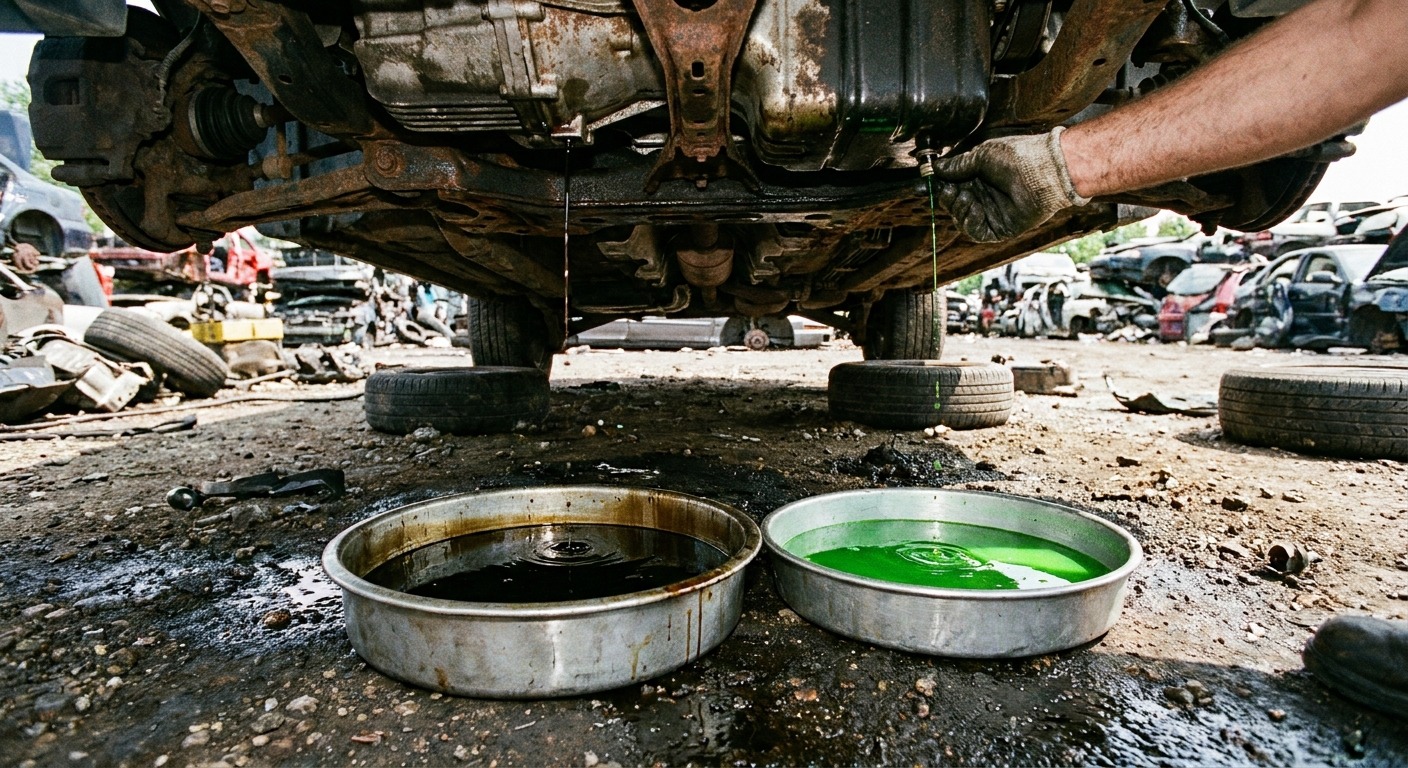
Before anything else happens, every fluid in the vehicle gets drained and captured. This is the single most environmentally critical step in the entire process, and it is where licensed recyclers earn their keep.
A typical passenger vehicle contains the following fluids:
- Engine oil
- 4 to 8 litres of used motor oil, collected for re-refining or energy recovery. One litre of waste oil can contaminate one million litres of water if dumped.
- Coolant (antifreeze)
- 6 to 12 litres of ethylene glycol solution. Toxic to animals, sweet-tasting, and lethal in small doses. Collected for recycling into new coolant.
- Transmission fluid
- 4 to 12 litres depending on the transmission type. Collected and sent for re-refining alongside other petroleum-based fluids.
- Brake fluid
- 0.5 to 1 litre of hygroscopic glycol-ether fluid. Small volume, significant contamination potential. Collected separately.
- Power steering fluid
- 0.5 to 1.5 litres. Petroleum-based, collected with other waste oils.
- Fuel (gasoline or diesel)
- Whatever remains in the tank, sometimes 50+ litres. Drained into approved storage containers. Gasoline is reused in yard equipment or sold; diesel likewise.
- Refrigerant
- R-134a or R-1234yf, recovered using certified equipment by licensed technicians. Refrigerant is a potent greenhouse gas — R-134a has a global warming potential 1,430 times that of CO2. Venting it is illegal under federal regulation.
- Windshield washer fluid
- A methanol-water mix, typically 3 to 4 litres. Low hazard but still captured.
A single vehicle can contain 30+ litres of hazardous or regulated fluids. Licensed auto recyclers capture all of them before any dismantling begins.
At a well-run facility, fluid recovery happens on a concrete pad with sealed drainage and oil-water separators. Nothing goes into the ground. This is the standard that ARS certification enforces, and it is light-years ahead of the backyard operations that give the industry a bad reputation.
Step 3: Hazardous Component Removal
After fluids come the solid hazardous components. These include:
- Mercury switches — found in trunk and hood convenience lights on vehicles built before 2003. Each switch contains roughly 1 gram of mercury. Programs like the national Switch Out program have recovered millions of these.
- Lead-acid batteries — 10 to 25 kg of lead and sulfuric acid per vehicle. Recycled at a rate above 98% in Canada, making them one of the most successfully recycled consumer products in existence.
- Airbag modules — contain small pyrotechnic charges (sodium azide propellant). Undeployed airbags must be either deployed in a controlled environment or removed and handled as hazardous goods.
- Catalytic converters — contain platinum group metals (platinum, palladium, rhodium) worth significant money. Removed and sold to specialized refiners who recover the PGMs.
Each of these streams has its own handling protocol, storage requirements, and downstream processor. A licensed recycler manages all of them as routine. Your blue bin program handles none of them.
Step 4: Parts Dismantling and Inventory
Now the vehicle becomes a parts source. Technicians remove components that have resale value: engines, transmissions, alternators, starters, body panels, doors, bumper assemblies, headlights, tail lights, mirrors, seats, instrument clusters, infotainment units, wheels, and tires.
Each part gets tagged, tested where applicable, and entered into an electronic inventory system. Most Canadian recyclers use networked databases that let repair shops search for parts across multiple yards simultaneously. When a mechanic in Winnipeg needs a left front fender for a 2019 Civic, the system shows availability at yards across the country.
This is where the consumer savings happen, but it is also where some of the biggest environmental gains occur. Every reused part is a part that did not need to be manufactured from scratch. The embedded energy and emissions of that avoided manufacturing are real and significant — as laid out in the carbon math of auto recycling.
Step 5: Crushing
Once a vehicle has been stripped of fluids, hazardous materials, and saleable parts, what remains is the hull — the body shell, frame, and whatever components were not worth removing individually. This hull gets crushed in a hydraulic car crusher, reducing it from a three-dimensional object the size of a parking space to a flat slab roughly 30 cm thick.
Crushing is about logistics. A flatbed truck that can carry 2 uncrushed hulls can carry 10 to 12 crushed ones. That efficiency matters because the next destination is often hundreds of kilometres away.
Step 6: Shredding and Separation
Crushed hulls get transported to a shredder — a massive industrial hammer mill that tears the compressed vehicle into fist-sized chunks in seconds. The raw shredder output is a mixed stream of ferrous metal, non-ferrous metal (aluminum, copper, zinc), rubber, plastic, fabric, glass, and dirt.
Separation happens in stages. Powerful magnets pull out the ferrous metal — this is the bulk of the output by weight and goes directly to steel mills. Eddy current separators eject non-ferrous metals, which get sorted further by type. Dense media separation, air classification, and hand sorting recover additional material.
The ferrous scrap from auto shredders is the largest single source of recycled steel in North America. It feeds electric arc furnaces that produce new steel at a fraction of the energy and emissions cost of ore-based production.
Step 7: Automotive Shredder Residue (ASR)
After metals are recovered, what remains is called automotive shredder residue, or ASR — sometimes called "fluff." It is a mix of plastics, rubber, foam, fabric, glass fragments, and dirt. ASR represents roughly 15 to 20 percent of a vehicle's original weight, and it is the biggest remaining challenge in end-of-life vehicle processing.
Historically, ASR went to landfill. Increasingly, it gets processed further. Some facilities use post-shredder technologies to recover additional plastics and metals. Some ASR gets used as alternative daily cover in landfills, which at least displaces virgin soil. Research into thermal processing (gasification, pyrolysis) continues, though commercial-scale deployment in Canada remains limited.
This is the honest part of the story. Not everything gets recycled perfectly. The 80 to 85 percent recovery rate means 15 to 20 percent still goes to managed disposal. The industry knows this and has been working on it for decades. But even with ASR factored in, the overall environmental performance of auto recycling beats almost every other material recovery system in the country.
80–85% of a vehicle's weight is recovered as reusable parts or recyclable material. The remaining 15–20% (ASR) is the industry's biggest ongoing challenge.
Why This Process Matters
The reason to walk through all seven steps is simple: this is what real recycling looks like. It is not a single-stream bin on the curb. It is a coordinated industrial process involving trained workers, specialized equipment, regulated hazardous material handling, and continent-spanning supply chains for recovered material.
When municipalities push back on auto recycling facilities in their jurisdictions, they are pushing back on the most effective material recovery system most Canadians will ever interact with. The vehicles written off by insurance companies do not vanish. They go through this process. And the process works.
Understanding it is the first step toward respecting it — and toward building policy that supports it instead of fighting it.