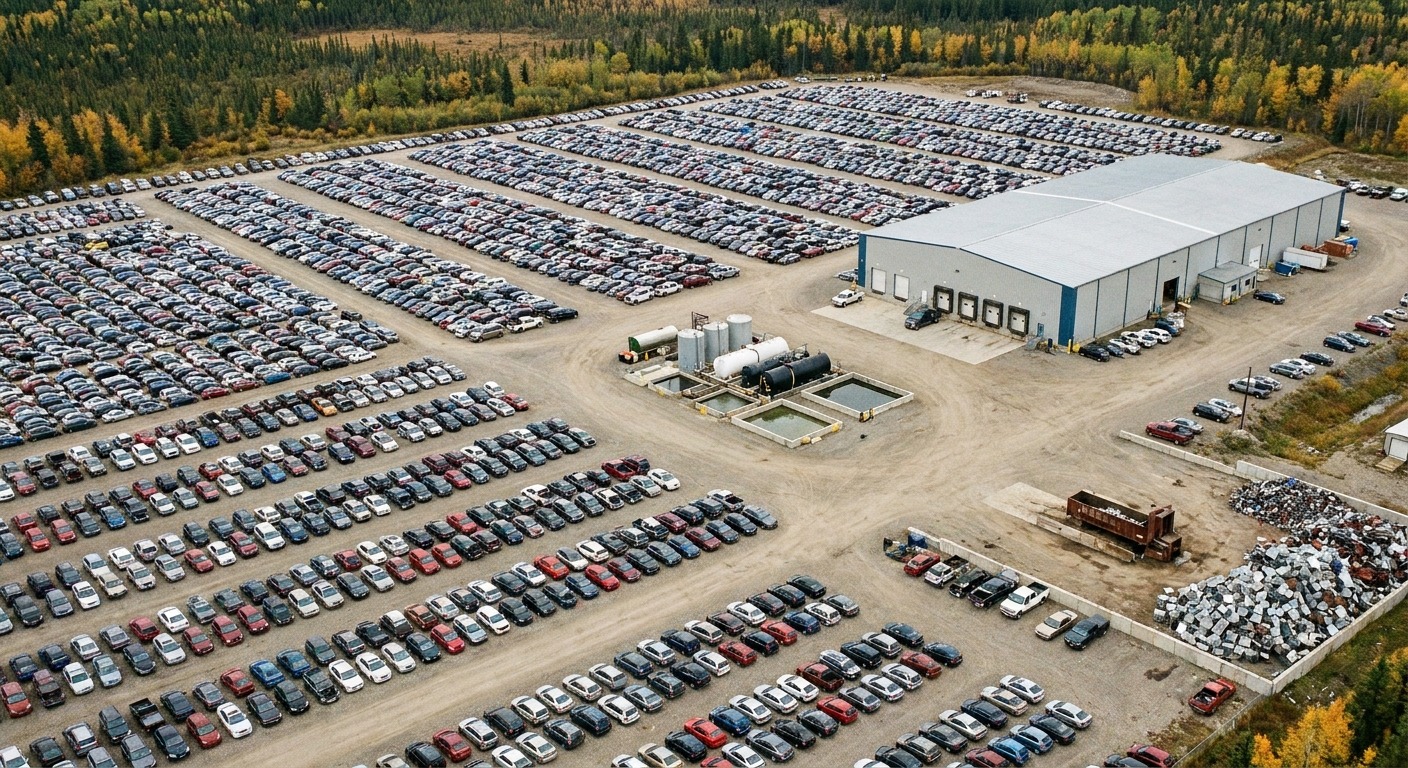
Say "junkyard" and most people picture a chaotic acre of rusting cars, puddles of oil, a chain-link fence, and a dog of uncertain temperament. That image comes from movies, from decades-old memories, and from a handful of operations that genuinely were that bad. It does not describe the modern Canadian auto recycling facility. The gap between perception and reality is so wide that it functions as its own kind of pollution — contaminating public opinion, zoning decisions, and environmental policy with an image that is 40 years out of date.
This is what a well-run yard actually looks like, zone by zone.
Reception and Intake
When a vehicle arrives — towed, flatbedded, or driven in — it enters a documented chain of custody. The intake process at a certified yard is closer to hospital admissions than it is to the "drive it in and leave the keys" of popular imagination.
The vehicle is logged with its VIN, make, model, year, colour, mileage, and the reason it has been declared end-of-life: insurance write-off, mechanical failure, age, collision damage. That data enters the yard's inventory management system, where it will track every part pulled, every fluid drained, and the eventual disposition of the hulk.
At yards operating under ARC certification, the intake process also includes a checklist for environmental compliance: are there visible fluid leaks, is the fuel tank intact, does the vehicle contain any non-automotive materials (people store remarkable things in cars they are sending to salvage). The vehicle is tagged and moved to the processing queue.
The Fluid Drainage Bay
This is the most environmentally critical zone in the entire operation, and it is the one that best illustrates the difference between a modern yard and its historical predecessors.
A proper fluid drainage bay sits on a sealed concrete pad — typically six to eight inches thick, sloped to a central collection point, with containment curbs around the perimeter. The pad is designed to capture any spill and route it to a sump, not to the surrounding soil. It is the same engineering principle used in fuelling stations and chemical handling facilities, and it is subject to the same provincial regulatory oversight.
8–12 different fluids are drained from a typical end-of-life vehicle: engine oil, transmission fluid, power steering fluid, brake fluid, coolant/antifreeze, windshield washer fluid, differential fluid, fuel, and refrigerant (recovered under federal ODS regulations).
Each fluid is collected separately into dedicated bulk tanks or drums. Engine oil goes to one tank, coolant to another, fuel to a third. Refrigerant — an ozone-depleting or high-GWP substance regulated under the Canadian Environmental Protection Act — is recovered using certified equipment by trained technicians. There is no venting, no mixing, no disposal into drains. The fluids are either picked up by licensed waste haulers for re-refining and recycling or, in the case of usable fuel, consumed on-site in equipment or resold where regulations permit.
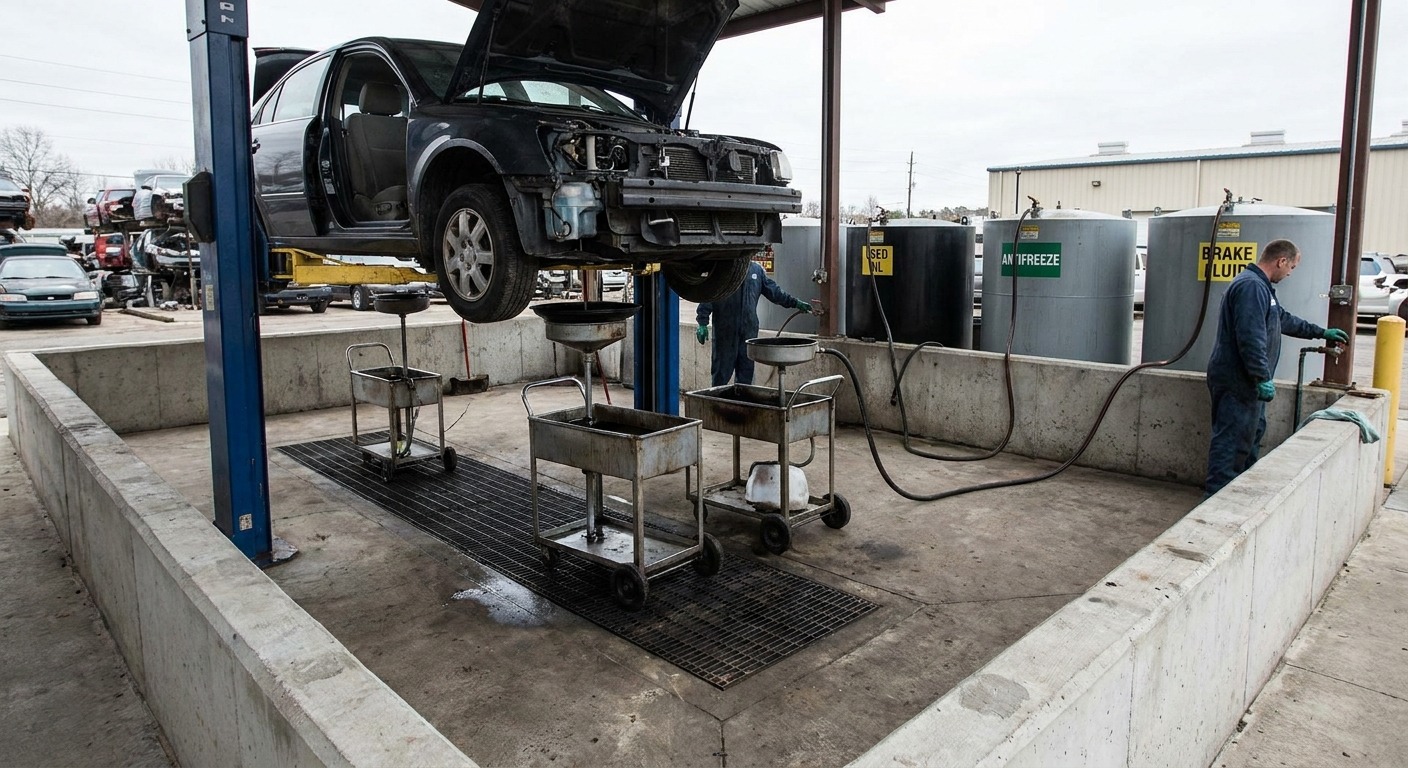
A single end-of-life vehicle can yield 15 to 25 litres of used oil, 10 to 15 litres of coolant, and 30 to 60 litres of fuel. Multiply that across hundreds or thousands of vehicles per year, and a single auto recycler is preventing tens of thousands of litres of hazardous fluids from reaching soil and groundwater annually. This is environmental protection at industrial scale, happening every day, largely unrecognized.
Parts Removal and Testing
Once fluids are drained, the vehicle moves to the dismantling area. Here, technicians remove parts that have resale value — engines, transmissions, alternators, starters, body panels, doors, lights, mirrors, electronic modules, and hundreds of other components depending on the vehicle's age, condition, and market demand.
This is skilled work. Technicians need to know which parts are interchangeable across model years, which components are prone to failure and therefore in high demand, and how to remove parts without damaging them. Many yards employ technicians with full automotive mechanic certification. The romantic notion of a guy with a wrench pulling random parts off a car in a field is as outdated as the image of the chaotic junkyard itself.
Parts are cleaned, inspected, and tested where applicable. Engines may be compression-tested. Electrical components are bench-tested. Body panels are graded for damage level. This is quality control, and it matters — because the yard's reputation depends on selling parts that work.
The Parts Warehouse
Walk into the parts storage area of a modern salvage yard and you will find something that looks more like an auto-parts store than a scrapyard. Parts are racked on industrial shelving, organized by category and vehicle application, and labelled with barcodes that link to the yard's digital inventory system.
Most Canadian yards of any significant size use one of two industry-standard inventory platforms: the Hollander Interchange system or a system compatible with URG (United Recyclers Group) databases. These platforms do several things: they catalogue every part by a standardized interchange number (so a 2015 Ford F-150 alternator is identifiable regardless of which yard has it), they track inventory across the yard in real time, and they feed into multi-yard search networks that let customers and shops find parts across the country.
Hollander Interchange — the industry-standard parts numbering system used by auto recyclers across North America. It enables cross-referencing of compatible parts across makes, models, and years.
When a customer calls looking for a specific part, the yard searches its system, confirms availability and condition, and can ship the part anywhere in Canada — often within 24 to 48 hours for parts in the delivery network. This is not rummaging through a field of cars looking for what you need. It is modern logistics applied to used parts, and it works.
The Crush Pad
Once a vehicle has been fully dismantled — all resaleable parts removed, all fluids drained, all hazardous materials extracted — what remains is the hulk: a steel shell stripped of its useful components. The hulk moves to the crush pad.
A car crusher — typically a horizontal baler or a flat-bed crusher with a hydraulic ram — compresses the hulk into a manageable shape for transport. Crushed hulks are stacked and loaded onto flatbeds for shipment to a shredder facility, where they are torn apart by massive hammer mills and the resulting material is sorted into ferrous metal, non-ferrous metal (aluminum, copper, zinc), and Automotive Shredder Residue (ASR).
The ferrous metal — primarily steel — goes to electric arc furnace (EAF) steelmakers, where it is melted and cast into new steel products. According to the World Steel Association, the non-ferrous metals are sorted and sold to specialized smelters and refineries. Steel recycling through this pathway uses roughly 75 percent less energy than producing steel from virgin iron ore.
ASR — the 15 to 20 percent of vehicle weight that is not currently recovered — consists of mixed plastics, rubber, foam, fabric, and glass. It is the remaining frontier for the industry. Research into ASR recovery technologies is ongoing, with pyrolysis and advanced sorting systems showing promise for reducing the landfill fraction further.
Environmental Monitoring
A modern yard does not simply meet environmental standards and forget about them. Active monitoring is part of daily operations. This typically includes:
- Stormwater management: yards maintain stormwater retention and treatment systems — often oil-water separators — that prevent contaminated runoff from reaching watercourses. Stormwater is tested periodically.
- Soil and groundwater monitoring: some jurisdictions require monitoring wells, particularly at sites with historical operations predating modern containment standards. Regular sampling confirms that current operations are not creating contamination.
- Spill response equipment: absorbent pads, booms, drain covers, and spill kits are maintained throughout the yard. Staff are trained in spill response procedures.
- Fluid storage integrity: bulk tanks are inspected regularly for leaks, and secondary containment systems (bermed areas, double-walled tanks) provide backup protection.
The level of environmental management at a certified Canadian auto recycler meets or exceeds what is required of many other industrial operations handling similar materials. The regulatory framework is multi-layered — federal requirements for ozone-depleting substances, provincial Environmental Compliance Approvals, municipal site plan controls — and compliance is a condition of continued operation.
The Gap Between Reality and Reputation
Put all of this together — the documented chain of custody, the engineered fluid recovery systems, the digital inventory, the environmental monitoring, the regulatory compliance — and you have an operation that bears no resemblance to the "junkyard" label that still gets applied. The modern Canadian salvage yard is a specialized recycling facility that happens to process vehicles. It is closer to a logistics hub with environmental controls than it is to the disorganized lot of public imagination.
The gap between what these operations are and how they are perceived has real consequences. It drives municipal opposition to new yards, makes zoning approvals unnecessarily difficult, and undermines public support for an industry that achieves recycling outcomes most other waste streams cannot match.
"People come in expecting a junkyard and leave saying it looks like a warehouse. That reaction — that surprise — tells you everything about the perception problem." — ARC-certified auto recycler, southern Ontario
If every resident who has opinions about auto wrecking yards spent an hour touring a certified operation, the political landscape would shift. They would see sealed concrete, not bare ground. Digital inventory screens, not piles of random parts. Labelled fluid tanks, not oil-stained puddles. The challenge is getting them through the gate in the first place, because the mental image they carry tells them they already know what is inside. They do not.