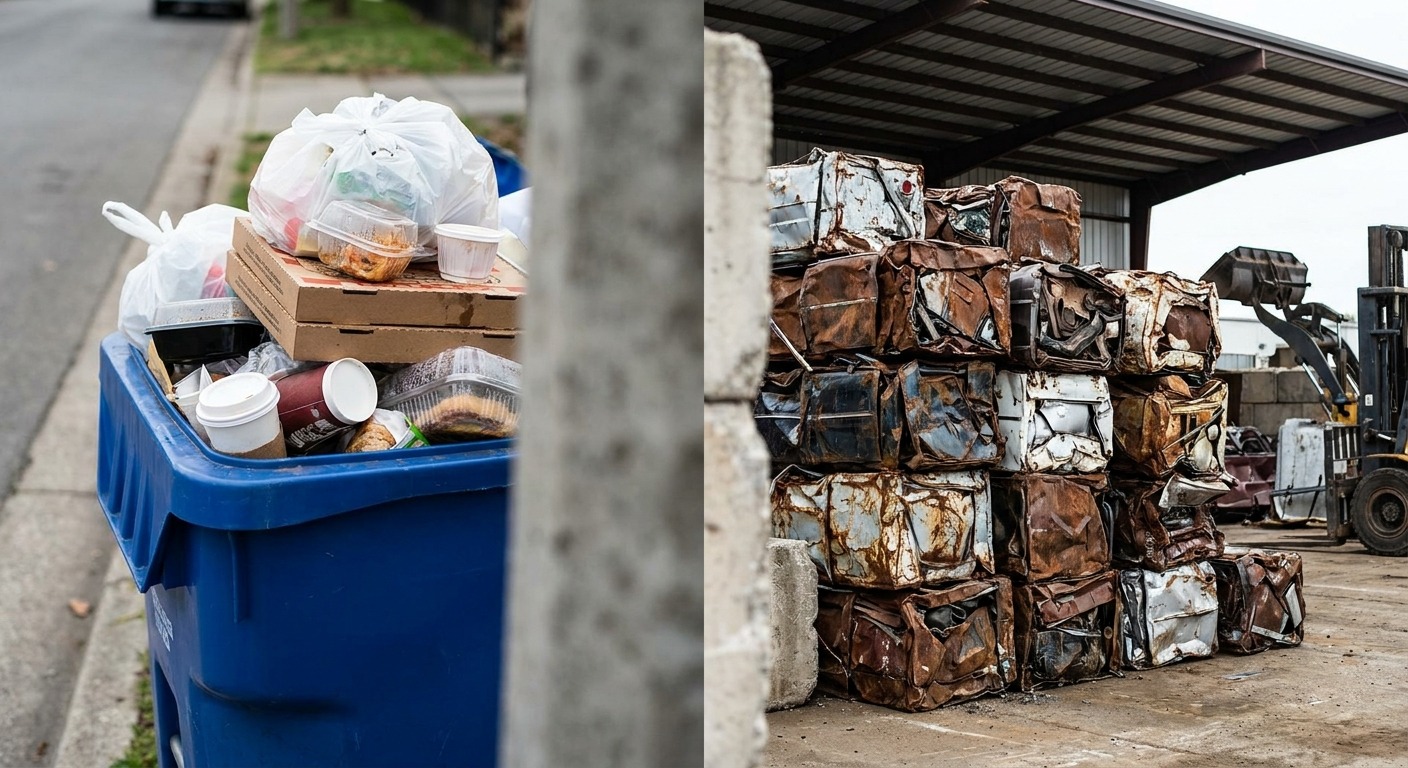
There is a ritual that takes place every week in Canadian households. You rinse a yogurt container — maybe — toss it in the blue bin, and feel a small glow of civic virtue. You are recycling. You are doing your part. Except there is a decent chance that container is going to end up in a landfill, or baled and shipped across the Pacific to become somebody else's problem. The word for this is wishcycling: the act of putting something in the recycling bin and hoping it gets recycled, regardless of whether the local system can actually process it.
Meanwhile, a few kilometres outside town, there is a business that recovers 80 to 85 percent of every unit of material it handles — by weight. It has been doing this for decades. It operates under environmental permits, handles hazardous fluids according to provincial regulations, and feeds recovered steel back into the manufacturing supply chain. That business is an auto wrecker. And in the public imagination, it is the dirty one.
This is the cognitive dissonance at the heart of Canadian recycling policy, and it is worth pulling apart.
The Blue-Bin Contamination Problem
Municipal curbside recycling programs across Canada report contamination rates ranging from 25 to over 30 percent. That means roughly a quarter of what goes into the blue bin should not be there — greasy pizza boxes, plastic bags, food-contaminated containers, textiles, electronics, and materials that look recyclable but are not accepted locally.
25–30% — typical contamination rate in Canadian municipal blue-bin programs, according to municipal waste audits conducted by the Resource Productivity and Recovery Authority (RPRA) in Ontario.
Contamination does not just mean that one bad item gets landfilled. A single bag of garbage tossed into a recycling cart can spoil an entire load. Material Recovery Facilities (MRFs) can reject bales that exceed contamination thresholds, and those bales go straight to landfill. The system is fragile in ways that the public is rarely told about.
Toronto, which runs one of the largest curbside programs in the country, has acknowledged contamination rates above 25 percent in its multi-residential recycling streams. Smaller municipalities often fare worse — they lack the sorting technology and economies of scale to deal with mixed loads. The irony is that many of these municipalities simultaneously promote their recycling programs as environmental success stories.
Where the Blue Bin Actually Goes
Even the material that makes it through the MRF is not guaranteed a second life. Before 2018, much of Canada's sorted recyclable material — particularly plastics — was shipped to China. Then China implemented its National Sword policy, setting contamination thresholds so strict that most Canadian bales could not meet them. The material was rerouted to Southeast Asian countries — Malaysia, Indonesia, Vietnam, the Philippines — many of which have since imposed their own import restrictions.
The global picture is bleak. A frequently cited figure from a 2017 study published in Science Advances found that only about 9 percent of all plastic ever produced has been recycled. The rest has been incinerated or accumulated in landfills and the environment. That number has not moved much since.
Some materials do get recycled at meaningful rates. Aluminum cans have a strong domestic market. Corrugated cardboard, when clean, is readily processed. But mixed plastics — the #3 through #7 codes that make up a significant portion of residential blue-bin volume — are difficult to recycle economically and often end up downcycled into lower-value products or simply landfilled after travelling thousands of kilometres.
This is the system we celebrate. This is the system that gets the green branding.
Auto Wrecking: The Recovery Rate Nobody Talks About
A modern auto recycler in Canada recovers between 80 and 85 percent of a vehicle's total weight. That figure comes from the Automotive Recyclers of Canada (ARC) and aligns with data from industry studies in Europe and the United States.
80–85% of a vehicle's weight is recovered through the auto recycling process — primarily steel, aluminum, copper, and reusable parts. The remaining 15–20% is Automotive Shredder Residue (ASR), which is the subject of ongoing recovery research.
The process is straightforward and thorough. When a vehicle arrives at a certified salvage yard, fluids are drained first — engine oil, transmission fluid, coolant, brake fluid, refrigerant, fuel. These are collected in sealed systems on concrete pads with containment sumps. Usable fluids are re-refined or sent to licensed processors. Then reusable parts are pulled, tested, catalogued, and warehoused. What remains — the hulk — is crushed and sent to a shredder, where ferrous and non-ferrous metals are separated magnetically and by eddy current.
Steel recovered from end-of-life vehicles is one of the most efficiently recycled materials on the planet. The World Steel Association reports that steel is recycled at rates exceeding 85 percent globally, and automotive steel is a primary feedstock for electric arc furnace steelmaking. This is not downcycling. Recycled steel has the same structural properties as virgin steel.
The Perception Gap
So why does the public trust the blue bin more than the wrecking yard? Part of it is proximity and aesthetics. The blue bin sits neatly at the curb. You do not see the MRF, the baling, the rejected loads, the ocean shipping, or the landfill at the end. It is a clean handoff. Out of sight, out of mind.
A wrecking yard, by contrast, is visible. It sits on a few acres of industrial land. There are stacked cars, heavy equipment, and the general appearance of a working industrial operation — because that is exactly what it is. And for many people, visible industry equals pollution. Never mind that the yard is operating under provincial environmental approvals and recovering material at rates the curbside program cannot approach.
There is also a class dimension that rarely gets discussed. Curbside recycling is something middle-class homeowners participate in. It is built into the municipal tax structure. Auto wrecking is blue-collar work, often run by family businesses in rural or semi-industrial areas. One gets a green halo; the other gets zoning complaints. The double standard is not subtle if you are paying attention.
Small Communities and the Recycling Reality Check
There is an interesting wrinkle in the recycling data. Some smaller communities actually achieve better material recovery outcomes than large cities — not because their curbside programs are more advanced, but because they are closer to the actual process. In a small town, you might know the person who runs the scrap yard. You might see the metal truck make its run. Recycling is not an abstraction; it is a visible local industry.
Small municipalities across Ontario and the Ottawa Valley have started maintaining resource directories that connect residents directly to local recyclers, salvage operators, and waste diversion services. You can find this kind of practical information through township waste management offices in places like Arnprior and Deep River, or through county-level recycling guides that many rural municipalities publish on their own websites. The common thread is directness — residents are pointed to actual facilities rather than vague instructions about what goes in which bin.
This proximity matters. When people understand where materials go and what happens to them, contamination drops. When recycling is an abstraction — toss it in the bin and let the system figure it out — contamination climbs. Urban curbside programs, by design, maximize the distance between the resident and the process. Auto recyclers, by necessity, operate in the middle of it.
The Numbers Do Not Lie
Let us put the comparison in plain terms:
- Municipal curbside recycling: contamination rate of 25–30%. Actual recycling rate for plastics in Canada estimated at under 10% (Environment and Climate Change Canada). Significant material exported or landfilled post-sorting.
- Auto recycling: 80–85% recovery by weight. Steel recycled at 85%+ rates globally. Fluids captured and re-refined. Parts reused directly, displacing new manufacturing.
One of these industries receives public funding, promotional campaigns, and municipal goodwill. The other faces zoning opposition, negative stereotyping, and regulatory suspicion. If we were serious about environmental outcomes rather than environmental optics, the priorities would be reversed.
This is not an argument against curbside recycling. Any diversion from landfill is better than none. But it is an argument for honesty — and for recognizing that the industries doing the heaviest lifting in material recovery are the ones getting the least credit.
What Would Honest Policy Look Like?
If Canadian municipalities evaluated recycling programs by actual recovery rates rather than participation rates, the policy landscape would shift overnight. A city that claims a 50 percent diversion rate while a quarter of its blue-bin volume is contaminated is reporting a vanity metric. Real accountability means tracking material to its final destination — not just to the MRF loading dock.
It would also mean acknowledging that steel recycling through auto wreckers and scrap processors delivers measurable, verifiable environmental benefits — and rethinking the way we zone, permit, and talk about the industrial operations that make recycling physically possible.
Auto wreckers are not asking for praise. They are asking to stop being treated as the problem when they are, by every measurable standard, a significant part of the solution. If you want to understand the gap between recycling performance and recycling perception, start by asking a simple question: what actually happens to the material after you hand it over? For blue bins, the answer is complicated and often disappointing. For auto recyclers, the answer is steel mills, re-refining plants, and parts warehouses.