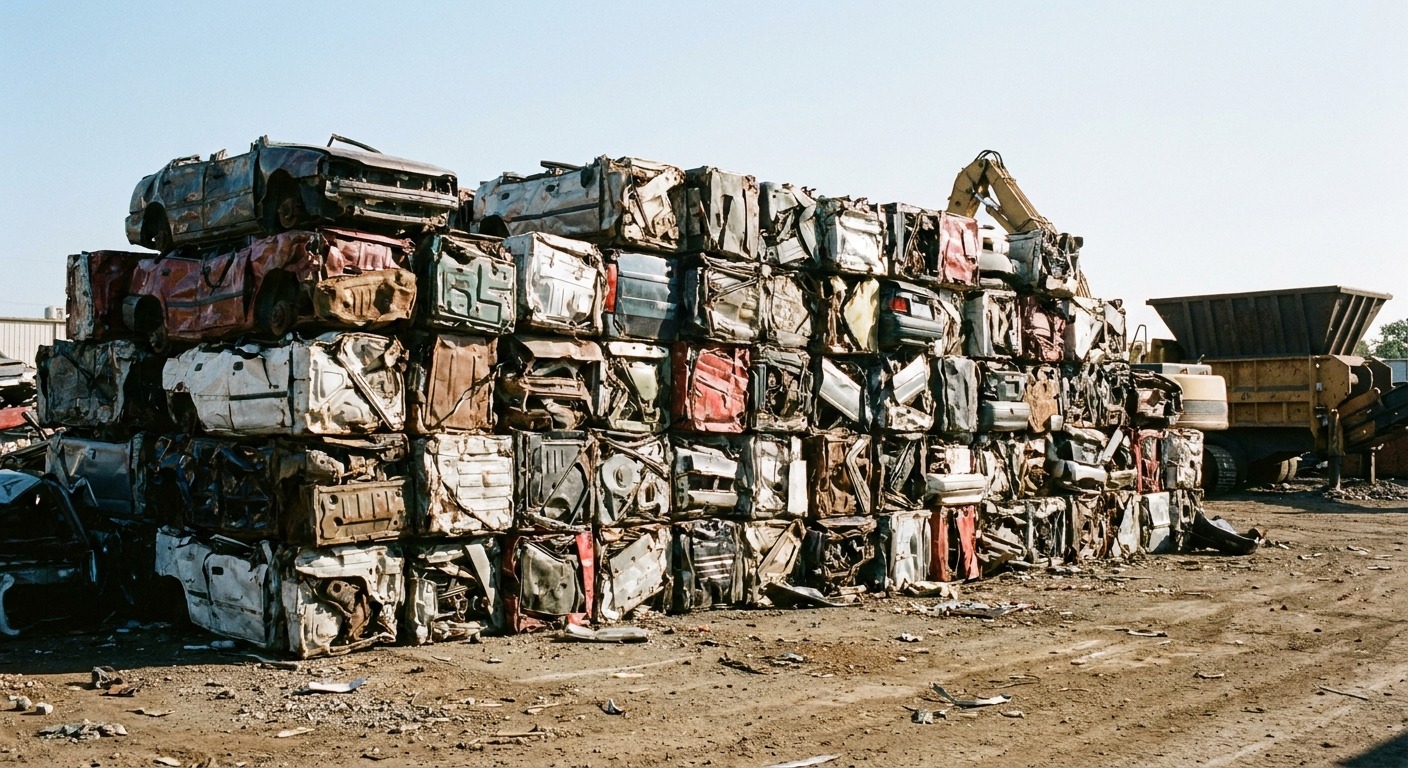
Everybody has an opinion about recycling. Most of those opinions were formed while rinsing out a yogurt container and wondering if the lid goes in the same bin. Meanwhile, a few thousand auto recyclers across Canada are quietly running one of the most effective material-recovery operations on the planet — and almost nobody counts their numbers when talking about the country's environmental performance.
That needs to change. Because the carbon math of auto recycling is not close. It is not marginal. It is overwhelming.
The Baseline: What Canada's Auto Recyclers Actually Process
The Automotive Recyclers of Canada (ARC) and provincial associations estimate that roughly 1.5 million end-of-life vehicles are processed through licensed auto recycling facilities in Canada every year. That is not a rounding error. That is a fleet the size of every registered vehicle in Manitoba and Saskatchewan combined, cycling through the system annually.
Each of those vehicles weighs between 1,200 and 2,000 kg. The industry-standard recovery rate sits at 80 to 85 percent by weight — meaning that for every tonne of car that rolls onto a recycler's lot, 800 to 850 kg of material gets diverted from landfill and fed back into manufacturing supply chains.
80–85% of a vehicle's total weight is recovered and recycled through licensed auto wrecking facilities — a rate that dwarfs municipal recycling programs.
Compare that to the municipal blue bin system. Statistics Canada and provincial auditor reports consistently show actual diversion rates in the range of 30 to 40 percent for residential curbside programs. Some municipalities claim higher, but those numbers often count material collected, not material actually reprocessed. Auto recyclers do not get that luxury. A crushed hull either gets melted down or it does not.
Steel: The 74% Number That Matters
Steel is the backbone of auto recycling. A typical passenger vehicle is 55 to 65 percent steel and iron by weight. When that steel gets recycled through an electric arc furnace (EAF), the energy savings are staggering.
According to the World Steel Association, recycling steel saves 74 percent of the energy required to produce steel from virgin iron ore. That is not a best-case lab number. That is the industry-wide benchmark, measured across global EAF operations and compared to the blast furnace / basic oxygen furnace (BOF) route that starts with mining.
74% less energy to produce steel from recycled scrap vs. virgin iron ore — World Steel Association data used globally by steelmakers and policy analysts.
Canada's auto recycling stream sends roughly 1 million tonnes of ferrous metal back into the steel supply chain every year. At 74 percent energy savings, the avoided emissions from steel alone make auto recyclers one of the most effective carbon-reduction operations in the country — and they receive almost zero credit for it in climate policy discussions.
The Salvaged Engine: Two Tonnes of CO2 You Never See
Steel gets the headlines, but the real carbon magic in auto recycling happens at the parts counter. When a salvage yard pulls a working engine from a wrecked vehicle and sells it to a shop doing a replacement, the carbon math is brutal in favor of reuse.
Manufacturing a new engine block requires mining and smelting aluminum or iron, machining dozens of precision components, assembling them in a factory that runs on grid power, and shipping the finished unit across the continent. Lifecycle assessments peg the embedded carbon of a new engine at roughly 2 tonnes of CO2 equivalent when you account for raw material extraction, manufacturing energy, and logistics.
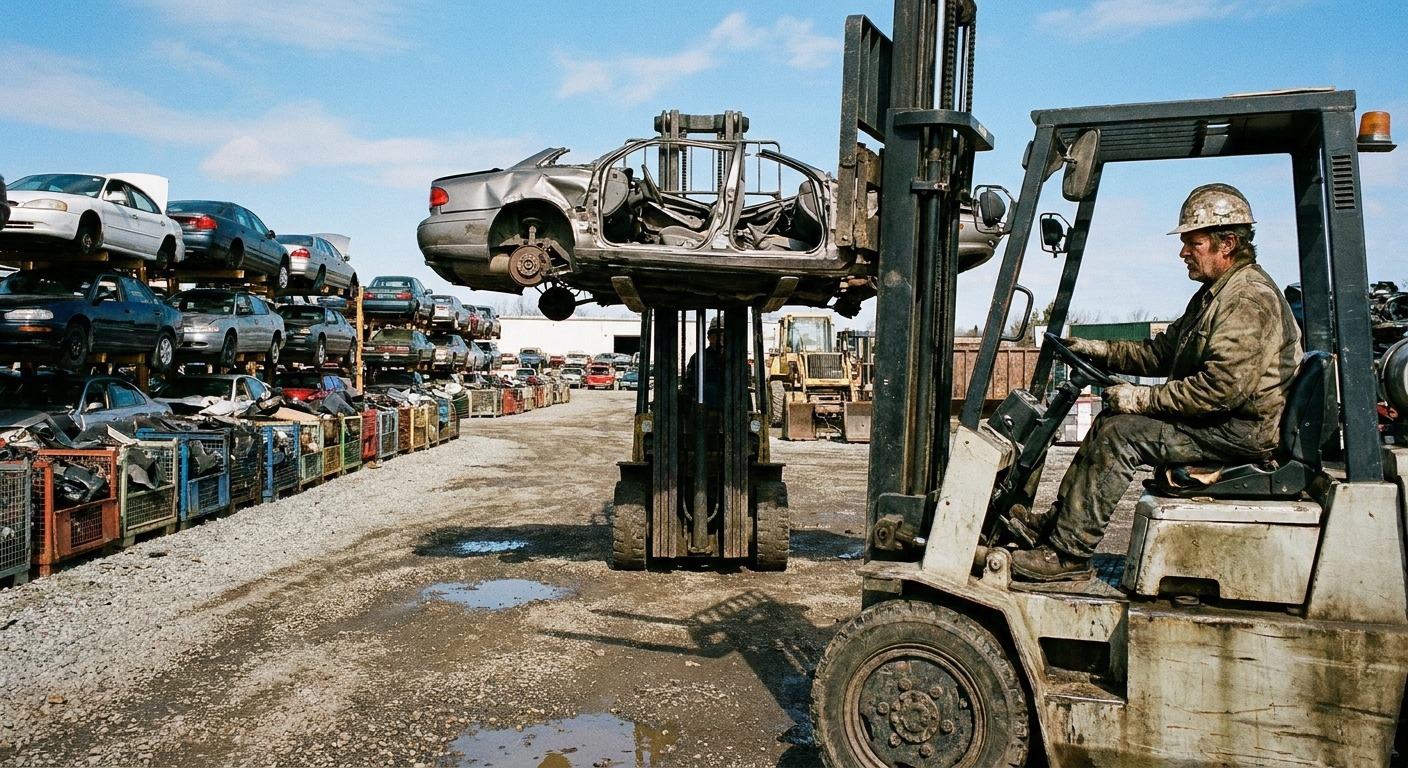
A salvaged engine requires a forklift, a hoist, and a truck ride to the shop. The carbon cost of reuse is a rounding error compared to new manufacturing. Multiply that by the hundreds of thousands of engines, transmissions, alternators, starters, and body panels that move through Canadian salvage yards every year and you start to see why used parts are not just cheaper — they are a climate strategy.
Non-Ferrous Metals: Aluminum, Copper, and the Rest
Steel dominates the weight breakdown, but modern vehicles also contain 100 to 200 kg of aluminum (engine blocks, wheels, body panels in newer models), 20 to 30 kg of copper (wiring harnesses, radiators, alternators), and smaller amounts of zinc, magnesium, and lead. Each of these metals has its own recycling energy advantage.
Recycling aluminum uses roughly 95 percent less energy than producing it from bauxite ore. For copper, the savings are around 85 percent. The non-ferrous stream from auto shredders is separated using eddy current technology and dense-media flotation, then sold to specialty smelters who process it back into usable alloy.
These secondary metal markets are mature and global. Canadian auto recyclers are net contributors to a supply chain that reduces mining pressure on landscapes from Quebec to British Columbia to the open-pit copper operations of Chile and Peru. The carbon savings per kilogram of recovered aluminum or copper are even higher than steel — they just get less attention because the total tonnage is smaller.
Why These Numbers Get Ignored
If auto recycling delivers such clear environmental wins, why is it not front and centre in Canadian climate plans? A few reasons:
- Optics. Salvage yards look industrial. They have mud, stacked cars, and forklifts. They do not look like the clean, aspirational version of environmentalism that gets photographed for annual reports.
- The NIMBY reflex. Municipalities routinely fight the presence of recycling operations while simultaneously claiming to champion green goals. The contradiction is rarely acknowledged.
- Measurement gaps. Auto recycling emissions reductions do not neatly fit into the reporting frameworks that governments use. Steel scrap goes to a mill in Hamilton or a mini-mill in the US — the carbon credit lands somewhere else in the accounting.
- Industry size. Auto recyclers are mostly small and medium businesses. They do not have lobbying budgets that compete with mining companies or automakers.
None of these are good reasons. They are just the actual reasons.
Comparing Apples to Apples: Auto Recycling vs. Municipal Programs
Let us put the numbers side by side. A licensed Canadian auto recycler processing 2,000 vehicles per year at an 83 percent recovery rate diverts roughly 2,500 tonnes of material from landfill annually. That single yard outperforms the actual diversion output of many small-town curbside programs serving 10,000 households.
The auto recycler also handles hazardous materials that municipal programs refuse to touch: refrigerants, mercury switches, brake fluid, transmission fluid, and lead-acid batteries. Every one of those streams has an environmental cost if mismanaged, and every one of them is handled as standard practice by certified recyclers.
The Full-Vehicle Carbon Picture
Researchers who study end-of-life vehicle processing estimate that the total avoided greenhouse gas emissions from recycling a single passenger car range from 5 to 10 tonnes of CO2 equivalent, depending on the vehicle's size, the proportion of parts reused vs. shredded, and the energy mix of the receiving steel mill.
At 1.5 million vehicles per year, even the conservative end of that range puts Canadian auto recycling's annual carbon avoidance in the neighbourhood of 7.5 million tonnes of CO2. For context, that is comparable to taking 1.6 million passenger cars off the road for a year, using Natural Resources Canada's standard emissions factor.
1.5 million end-of-life vehicles processed annually in Canada, each avoiding an estimated 5–10 tonnes of CO2 through material recovery and parts reuse.
These are not theoretical gains. They are happening right now, in every province, at facilities that most Canadians drive past without a second thought.
What Actually Needs to Happen
The fix is straightforward. Canadian climate policy needs to count what auto recyclers actually do. Provincial environment ministries need to integrate end-of-life vehicle processing into their emissions accounting. And municipalities need to stop treating salvage yards as nuisances while simultaneously failing to meet their own waste diversion targets.
The steel recycling numbers are settled science. The parts-reuse carbon savings are well-documented. The recovery rates are auditable. What is missing is political will and honest accounting.
Auto recyclers did not get into this business to save the planet. They got into it because there is money in pulling good parts off wrecked cars and selling scrap metal. But the environmental outcome is the same regardless of motive — and it is time the numbers got the respect they deserve.