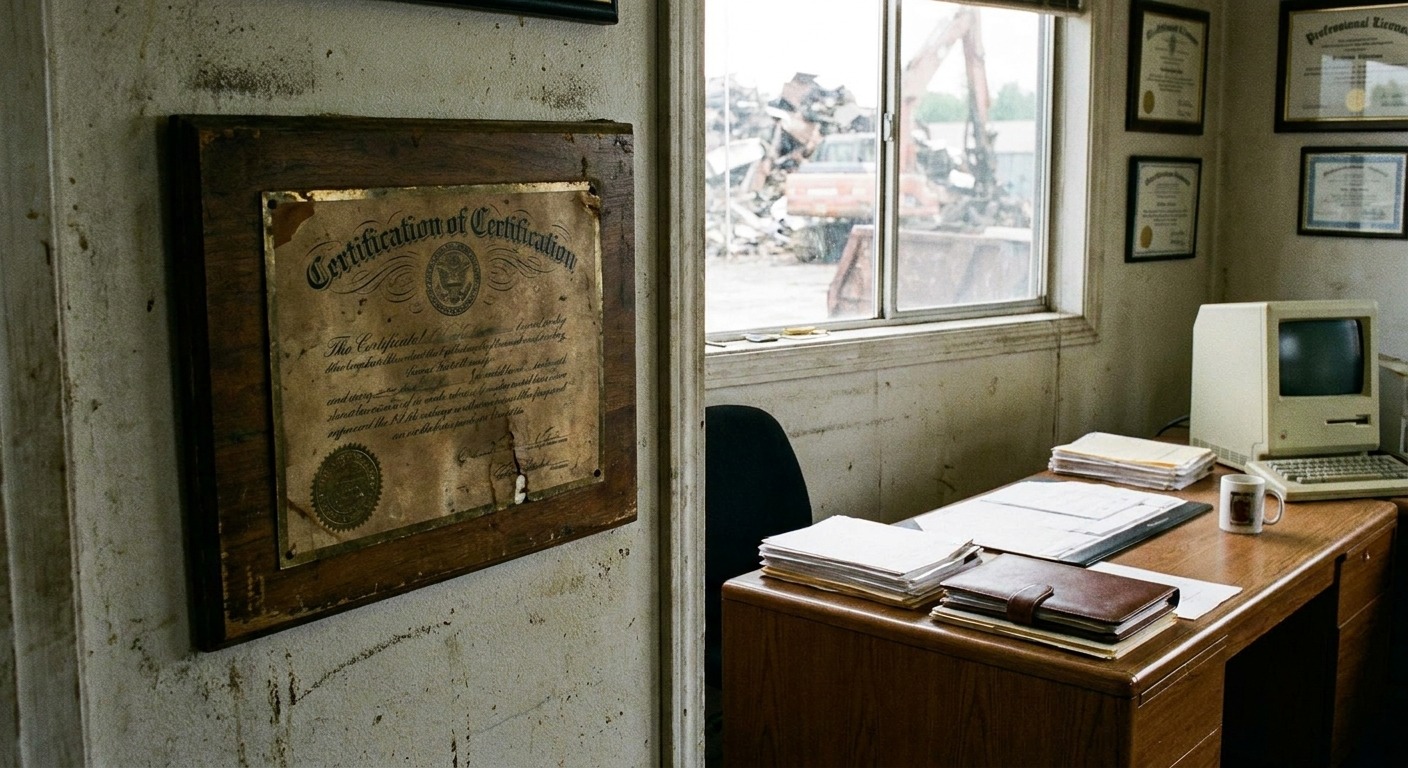
Ask most Canadians what separates a reputable auto recycler from a questionable one and you will get a blank stare. There is no consumer-facing rating system, no Google-review equivalent that measures environmental compliance, and no provincial public scorecard. What does exist is a voluntary industry certification program run by Automotive Recyclers of Canada (ARC) — and understanding what it requires is the single best shortcut to knowing whether a yard takes its obligations seriously.
ARC certification is not a badge you buy. It is a documented operational standard with auditing, environmental requirements, and ongoing compliance expectations. It is also not universally adopted, which is both a limitation and a telling indicator of industry dynamics. Here is what the certification actually involves, why it matters, and why some yards resist it.
What ARC Certification Requires
The ARC certification program — formally the Canadian Auto Recyclers' Environmental Code (CAREC) — establishes standards across several operational categories. A yard seeking certification must demonstrate compliance in all of them, not just the ones that are convenient.
- Environmental compliance
- The yard must hold all required provincial and municipal environmental approvals and demonstrate active compliance — not just having the paperwork, but following the conditions. This includes current permits, up-to-date reporting, and no outstanding environmental orders or violations.
- Fluid management protocols
- Detailed procedures for extracting, storing, and disposing of all vehicle fluids: engine oil, transmission fluid, coolant, brake fluid, power steering fluid, fuel, washer fluid, and refrigerant. Each fluid type has specific handling requirements. Storage must meet containment standards with secondary containment for bulk tanks.
- Parts testing and quality standards
- Salvage parts must be evaluated and graded before sale. Electrical components require bench testing. Mechanical components require visual inspection at minimum, with functional testing where practical. Parts must be accurately described and graded using a standardized system.
- Record keeping and traceability
- Every vehicle must be documented from acquisition through processing. Records must include vehicle identification, source documentation, parts inventory, waste disposal manifests, and customer sales records. This creates a chain of custody that regulators and auditors can verify.
- Insurance requirements
- Certified yards must carry adequate business liability insurance plus environmental liability coverage — a more expensive and comprehensive policy than basic commercial insurance that covers potential contamination events.
- Facility standards
- Physical facility requirements including impermeable surfaces in processing areas, proper drainage systems, organized storage, adequate fire prevention equipment, and safe working conditions for employees.
How Certification Differs from a Business Licence
This is the critical distinction that consumers, insurers, and municipal officials often miss. Having a business licence means you registered with the municipality and possibly the province. It means you paid a fee and met basic zoning requirements. It does not, in most jurisdictions, mean anyone verified your environmental practices, inspected your fluid management, or confirmed that you test parts before selling them.
The gap between the two is substantial:
| Requirement | Business Licence Only | ARC Certified |
|---|---|---|
| Municipal registration | Yes | Yes |
| Provincial env. approval | Required but not always verified | Verified and audited |
| Fluid management audit | No | Yes — documented protocols |
| Parts testing standard | No | Yes — grading and testing required |
| Environmental liability insurance | Not typically required | Required |
| Third-party audit | No | Periodic audits |
| Employee training standards | Basic workplace safety | Environmental and safety training documented |
When a consumer buys a part from an ARC-certified yard, they are getting a component from a facility that has been evaluated against a documented standard. When they buy from a non-certified yard, they are relying entirely on the operator's self-reported practices and whatever provincial enforcement has or has not occurred.
The Audit Process
ARC certification is not self-declared. The process involves an initial evaluation followed by periodic audits to confirm ongoing compliance. Auditors examine physical facilities, review documentation, and verify that stated procedures match actual practice.

The audit covers the full operational cycle:
- Vehicle intake: How vehicles are received, documented, and assessed for parts value and processing requirements
- Depollution: The sequence and methods used to remove all fluids and hazardous materials, with attention to containment and spill prevention
- Parts removal and testing: Whether parts are properly evaluated, tested where required, graded accurately, and stored appropriately
- Waste management: How non-reusable materials are classified, stored, and disposed of through licensed channels
- Record keeping: Whether documentation is current, complete, and accessible for the required retention period
- Facility condition: Physical infrastructure including containment surfaces, drainage, storage areas, and safety equipment
A yard that fails an audit does not simply get a warning. Certification can be suspended or revoked, and the deficiencies must be corrected before reinstatement. This creates genuine accountability that the basic regulatory framework — with its infrequent provincial inspections — often cannot provide.
Why Some Yards Resist Certification
If ARC certification is a mark of quality and environmental responsibility, why does not every yard pursue it? The reasons are a mix of legitimate concern and less defensible resistance.
Cost is the most cited barrier. Certification involves application fees, audit costs, and — more significantly — the capital investment required to meet facility standards. A yard that has been operating on gravel surfaces will need to pour concrete. A yard without proper secondary containment will need to install it. A yard without a systematic inventory management system will need to implement one. These are real costs, particularly for smaller operators.
"Certification cost me about $80,000 in facility upgrades over two years, plus annual fees and audit costs. For a yard running 400 vehicles a year, that's significant. But I'd argue it's the cost of doing business properly." — ARC-certified recycler, Ontario
Philosophical resistance is also a factor. Some operators, particularly long-established family yards, view ARC as a layer of bureaucracy imposed by a national organization that does not understand local conditions. There is a cultural independence streak in the industry — these are people who built businesses with their hands and are not naturally inclined to welcome outside auditors.
Competitive concern plays a role too. If certified yards invest in compliance and non-certified yards do not, the non-certified operators have lower overhead and can undercut on pricing. This only changes if consumers, insurers, or regulators meaningfully differentiate between certified and non-certified yards — which, currently, most do not.
Understanding these dynamics is important because they shape the broader regulatory conversation about the industry. Mandatory certification would eliminate the competitive distortion but could also force marginal operators out of business, potentially reducing salvage parts supply in underserved areas.
What Consumers Should Look For
If you are buying a salvage part — whether directly from a yard or through a repair shop that sources from one — ARC certification is the single most reliable indicator of a professional operation. But it is not the only thing to consider.
- Ask about warranty: Professional yards offer 30 to 90 day warranties on most parts, with longer coverage on major components. No warranty is a red flag
- Check for parts grading: A yard that can tell you the specific condition grade of a part (mileage, visual condition, test results) is operating at a higher standard than one that just pulls and sells
- Look at the facility: If you visit, note whether the processing area has paved/sealed surfaces, whether fluids are contained and organized, and whether the operation appears systematic rather than chaotic
- Verify licensing: A legitimate yard should be able to provide its provincial environmental approval number and municipal business licence on request
- Check industry membership: ARC membership, provincial auto recycler association membership, or Better Business Bureau registration all indicate a yard that operates within established business networks
The difference between a professional, certified operation and a substandard one is not subtle. It is visible in the facility, measurable in the documentation, and reflected in the product quality. The characteristics of a well-run auto recycler are identifiable if you know what to look for.
The Future of Industry Standards
The trend across Canadian provinces is toward higher environmental standards for all industrial operations, including auto recycling. Several developments are pushing the certification question forward:
- Insurance companies are beginning to preference certified yards for salvage parts sourcing in some markets
- Provincial regulators in Ontario and BC have engaged with ARC on aligning certification standards with regulatory requirements
- The growing public interest in verified environmental claims is making certification more commercially valuable
- Younger operators entering the industry tend to view certification as a market differentiator rather than an imposition
Whether ARC certification or something equivalent eventually becomes mandatory in some provinces remains an open question. What is not in question is the direction: the bar for acceptable auto recycling practice is rising, and the operators who invested early in proper environmental management, parts quality systems, and documented procedures are the ones best positioned for whatever regulatory future emerges.
For now, ARC certification remains the most accessible signal of quality in an industry that still lacks a universal consumer-facing standard. It is not perfect. Not every uncertified yard is bad, and certification alone does not guarantee every part will be flawless. But as a systematic indicator of operational seriousness, it is the best tool available — and consumers, shops, and insurers who use it as a filter are making a smarter choice than those who do not.
For the broader regulatory context that ARC certification sits within, see our overview of provincial differences in end-of-life vehicle rules and the full picture of how insurance write-offs flow through the system.