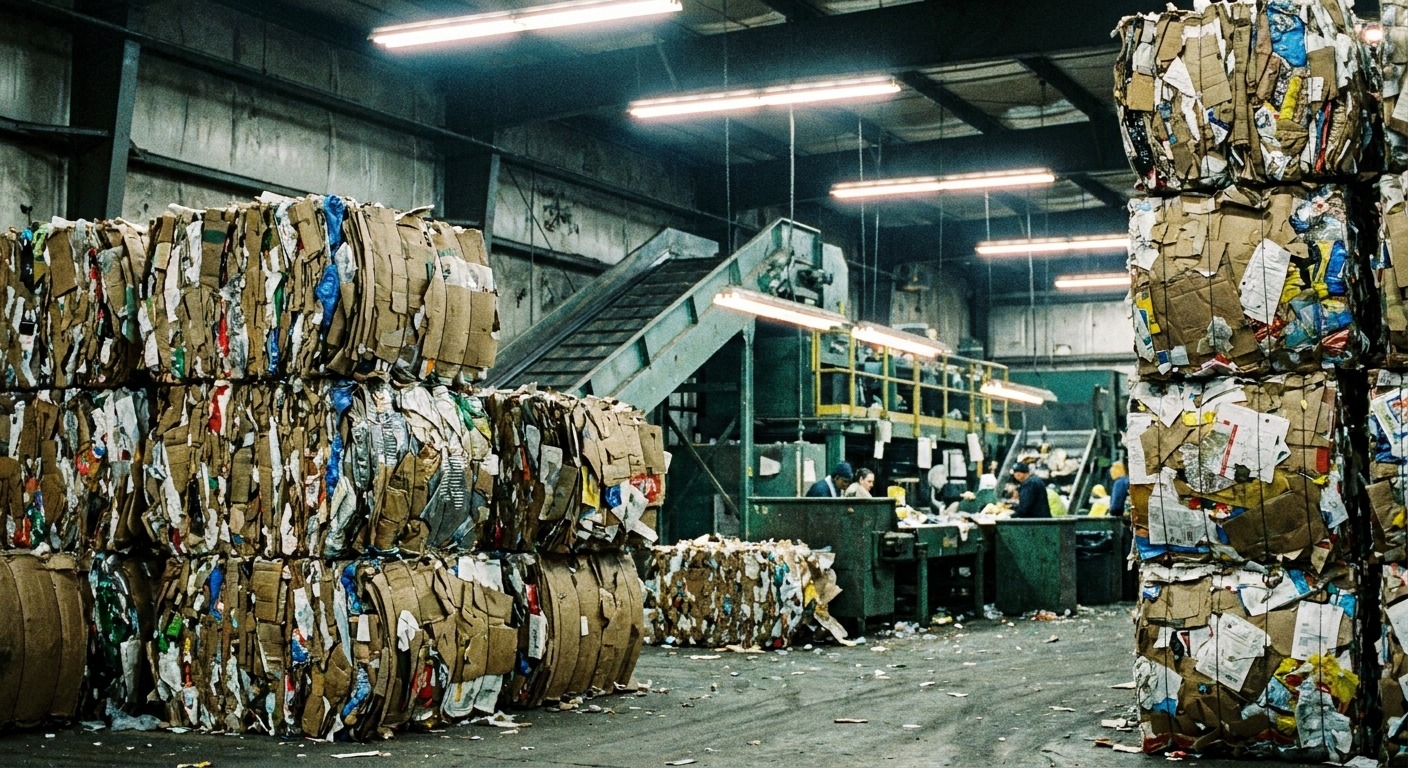
You sort your recyclables. You rinse the containers. You put the blue bin at the curb every other week and tell yourself you are doing the right thing. And you might be — for some materials, sometimes, in some municipalities. But the full journey of your blue-bin contents is longer, more complicated, and more disappointing than almost anyone realizes. If you tracked a single plastic container from your kitchen counter to its final destination, you would find a system that is less "recycling" and more "logistics followed by hope."
Step One: The Curb
Your blue bin is collected by a municipal truck or contracted hauler and taken to a Material Recovery Facility, usually called a MRF (pronounced "murf"). In larger Canadian cities — Toronto, Vancouver, Calgary, Ottawa — the MRF is likely a large, semi-automated facility with optical sorters, screens, magnets, and eddy current separators that divide the incoming stream into material categories: paper fibre, PET (#1 plastic), HDPE (#2 plastic), aluminum, steel, glass, and mixed plastics.
In smaller municipalities, the MRF might be a simpler operation with more manual sorting. Some communities share MRFs through regional agreements. Others truck material long distances to the nearest facility. The key point: when the truck leaves your curb, the recycling has not happened yet. It has barely begun.
Step Two: The Sort
At the MRF, the incoming stream is dumped on a tipping floor and fed onto conveyor belts. Workers do an initial pass to remove obvious contaminants — plastic bags, food waste, textiles, electronics, anything that should not be there. Then the automated systems take over.
The contamination problem starts here. Canadian MRFs report that 25 to 30 percent or more of incoming material is non-recyclable contamination. That material has to be pulled off the line and sent to landfill. It has already been collected, trucked, and processed — consuming fuel, labour, and money — before being thrown away.
25–30% of material arriving at Canadian MRFs is contamination that must be removed and landfilled, according to waste audits from Ontario's Resource Productivity and Recovery Authority.
Even the "clean" material is imperfect. Optical sorters misidentify items. Wet paper fibre degrades in quality. Plastics of different types get mixed. The sorted output is graded by contamination level, and lower-grade bales are worth less — sometimes so little that they have negative value, meaning someone has to pay to take them away.
Step Three: The Bale and the Broker
Sorted material is baled — compressed into large cubes wrapped in wire — and sold to commodity brokers. This is where the recycling chain becomes a supply chain, subject to the same market forces as any other commodity. If the price of virgin plastic drops, demand for recycled feedstock drops with it. If paper fibre markets are oversupplied, bales sit in warehouses or sell at losses.
Canadian municipalities typically do not process recyclable material themselves. They sell it, and the buyer determines what happens next. For aluminum and clean steel, the domestic market is reliable. For clean corrugated cardboard, there are domestic mills. But for mixed plastics and lower-grade paper fibre, the buyer is often an export broker, and the destination is overseas.
Step Four: The Ship
Before 2018, a massive portion of the world's recyclable material — including a significant share of Canada's — was shipped to China. China was the world's largest importer of recyclable waste, processing it into raw materials for its manufacturing economy. The economics were simple: container ships arrived full of Chinese goods and returned to Asia with recyclable material as ballast cargo, keeping shipping costs low.
Then, on January 1, 2018, China's National Sword policy took effect. The policy set contamination thresholds of 0.5 percent for imported recyclable material — a standard that virtually no Canadian MRF could meet. Overnight, the primary market for a large fraction of Canada's recyclable exports disappeared.
0.5% — China's National Sword contamination threshold for imported recyclable material. Most Canadian MRFs produce bales with contamination rates many times higher.
The material was redirected. Southeast Asian countries — Malaysia, Indonesia, Vietnam, the Philippines, Thailand — saw surges in recyclable waste imports. CBC reported extensively on the crisis, documenting how Canadian recyclable material ended up in countries with limited processing infrastructure and weak environmental enforcement. Several of these countries have since imposed their own import restrictions, and some have shipped contaminated loads back to their countries of origin.
Step Five: The Reality Check
So where does your blue-bin material end up? The honest answer depends on what it is:
- Aluminum cans
- Strong domestic market. High recycling rate. Aluminum is one of the few materials where curbside recycling consistently works as advertised.
- Steel cans
- Reliable domestic market through scrap processors. Steel recycling infrastructure in Canada is well-established.
- Clean corrugated cardboard
- Domestic mills in Ontario and Quebec take most of the supply. When contaminated with food or moisture, it loses value rapidly.
- PET (#1) and HDPE (#2) plastics
- Some domestic processing capacity. These are the "good" plastics — the water bottles and detergent jugs. Recovery rates are reasonable but not universal.
- Mixed plastics (#3–#7)
- Very limited domestic market. Often exported, downcycled into low-value products (park benches, lumber substitutes), or landfilled. These are the plastics that drive the most wishcycling.
- Glass
- Collected but often crushed and used as aggregate or landfill cover — technically "diverted" but not recycled into new glass in most Canadian systems.
The overall picture is one of selective success and systemic dishonesty. Aluminum and steel recycling work. Paper fibre mostly works. Plastics, particularly mixed plastics, are a problem that curbside programs have not solved and may never solve at current technology and economics.
The 9 Percent Stat
In 2017, researchers Roland Geyer, Jenna Jambeck, and Kara Lavender Law published a comprehensive study in Science Advances tracking the fate of all plastic ever produced. Their finding: of the 8.3 billion tonnes of virgin plastic produced globally through 2015, only about 9 percent had been recycled. Twelve percent had been incinerated. The remaining 79 percent had accumulated in landfills or the natural environment.
9% — the share of all plastic ever produced that has been recycled. 79% sits in landfills or the environment. (Geyer, Jambeck, and Law, Science Advances, 2017)
That number has not changed dramatically since. Canada's own Environment and Climate Change Canada data confirms that domestic plastic recycling rates remain well below what the public expects. The blue bin creates an illusion of circularity that the numbers do not support.
While curbside recycling struggles with contamination, export dependency, and dismal plastic recovery rates, auto recyclers quietly recover 80 to 85 percent of every vehicle by weight. The comparison is instructive because it highlights what effective material recovery actually requires: specialized handling, established domestic markets for the output materials, and a process designed around the specific material stream.
Auto recyclers are not trying to sort 47 different material types from a mixed residential stream. They are processing a single, well-understood product — a vehicle — through a standardized sequence: fluid recovery, parts extraction, shredding, and metal separation. The dominant output material is steel, which has a reliable domestic market and can be recycled indefinitely without quality loss.
The contrast is not flattering to curbside programs. Auto recycling works because it is designed around industrial efficiency and material-specific processing. Curbside recycling was designed around public convenience and political optics. One delivers results. The other delivers blue bins.
What Should Change
The core problem is not that Canadians are sorting incorrectly, although they are. The core problem is that the system was built on the assumption that overseas markets would absorb whatever we collected, at whatever contamination level we produced. That assumption collapsed in 2018 and has not recovered.
Meaningful reform would involve several uncomfortable steps:
- Honest accounting. Municipalities should report actual recycling rates — material confirmed as reprocessed into new products — not diversion rates that count material as "recycled" when it leaves the MRF.
- Domestic processing capacity. Canada needs more domestic reprocessing infrastructure, particularly for plastics. Without it, we are dependent on export markets that can disappear overnight.
- Extended Producer Responsibility. Several provinces have moved toward EPR frameworks that shift recycling costs to producers. This is a step in the right direction, because it creates financial incentives to design packaging that is actually recyclable.
- Recognition of what works. Industrial recycling — steel processing through scrap yards and auto recyclers, aluminum recovery, copper recycling — delivers proven results. These industries should be supported and expanded, not stigmatized.
The auto recycling industry figured out closed-loop material recovery decades ago. The curbside program is still trying. That is not an argument against curbside recycling. It is an argument for understanding the difference between a system that works and a system that makes you feel like you are working.
"People get angry when you tell them their recycling might not be getting recycled. But if we can't be honest about the problem, we can't fix it." — Waste management consultant, Toronto
The next time you put your blue bin at the curb, you are not recycling. You are offering material to a system that may or may not recycle it, depending on contamination levels, commodity prices, and export market conditions. When an auto recycler takes in a vehicle, by contrast, that vehicle will be recycled — fluids captured, parts reused, metals recovered. The certainty of outcome is the difference, and it is not a small one.