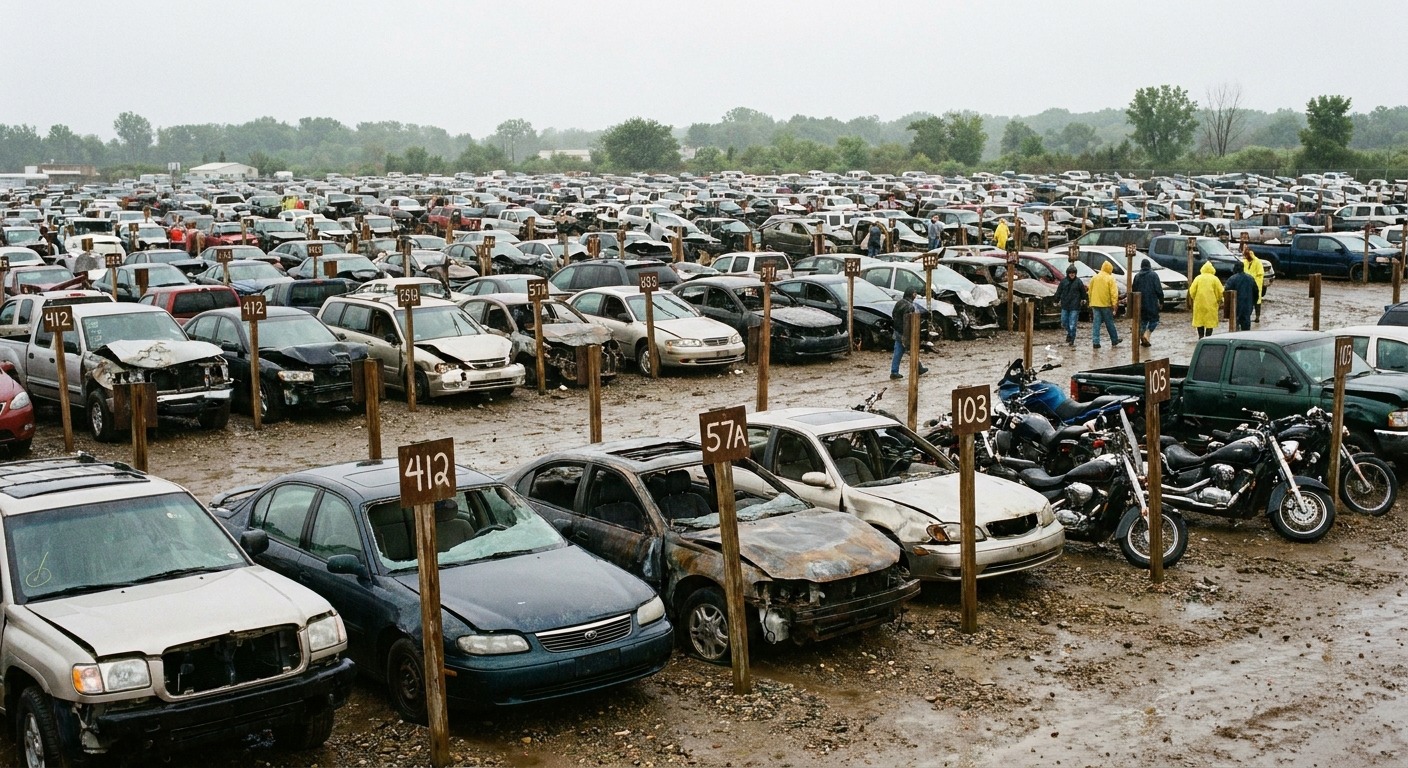
Every year in Canada, roughly half a million vehicles reach the end of their road. Not because they have nothing left to give, but because an insurance adjuster ran the numbers and decided the repair cost exceeded a threshold. The vehicle is declared a total loss, a cheque is written, and the car disappears from the owner's life. Most people never think about what happens next.
What happens next is one of the most efficient material recovery systems in the country. It is also one of the least understood. The chain of custody from write-off declaration to salvage yard to parts shelf to metal shredder is a structured process with rules, economics, and environmental protocols at every stage. Here is how it works.
How Many Vehicles Get Written Off
The exact number fluctuates by year, driven by collision rates, weather events, theft recovery rates, and the age profile of Canada's vehicle fleet. But the ballpark has been consistent for years.
The Insurance Bureau of Canada tracks claims data nationally, and provincial regulators maintain salvage title registries. The figure includes all categories: collision damage, comprehensive claims (flood, fire, hail, vandalism), theft recoveries, and occasional mechanical total losses on older vehicles where a major component failure exceeds the car's value.
Canada's vehicle fleet numbers over 26 million registered vehicles. A write-off rate of roughly 2% annually is normal for a northern climate with serious winter driving conditions, high wildlife collision rates in rural areas, and an aging fleet — the average Canadian vehicle is now past 12 years old.
The Total Loss Threshold
When an insurer declares a vehicle a total loss, it means the estimated repair cost has crossed a threshold relative to the vehicle's actual cash value (ACV). This threshold is not uniform across the country.
| Province | Typical Threshold | Notes |
|---|---|---|
| Ontario | ~70–75% of ACV | No legislated percentage; insurer discretion |
| Quebec | ~75% of ACV | SAAQ involvement for road safety inspections on rebuilt titles |
| British Columbia | ~75–80% of ACV | ICBC (public insurer) sets threshold internally |
| Alberta | ~70–80% of ACV | Private market; varies by insurer |
| Saskatchewan | ~70% of ACV | SGI (public insurer) applies consistent standard |
| Manitoba | ~70% of ACV | MPI (public insurer) sets threshold |
The key concept is that the threshold is not 100%. A car worth $10,000 does not need $10,000 in damage to be written off. It typically needs $7,000 to $8,000. The gap accounts for diminished value, rental car costs, administrative overhead, and the salvage value the insurer expects to recover by selling the wreck.
This means a significant number of written-off vehicles still have substantial usable components. A car that was rear-ended hard enough to total it may have a perfectly functional engine, transmission, and entire front clip. That is precisely why the salvage industry exists.
The Chain: From Insurance to Auction to Yard
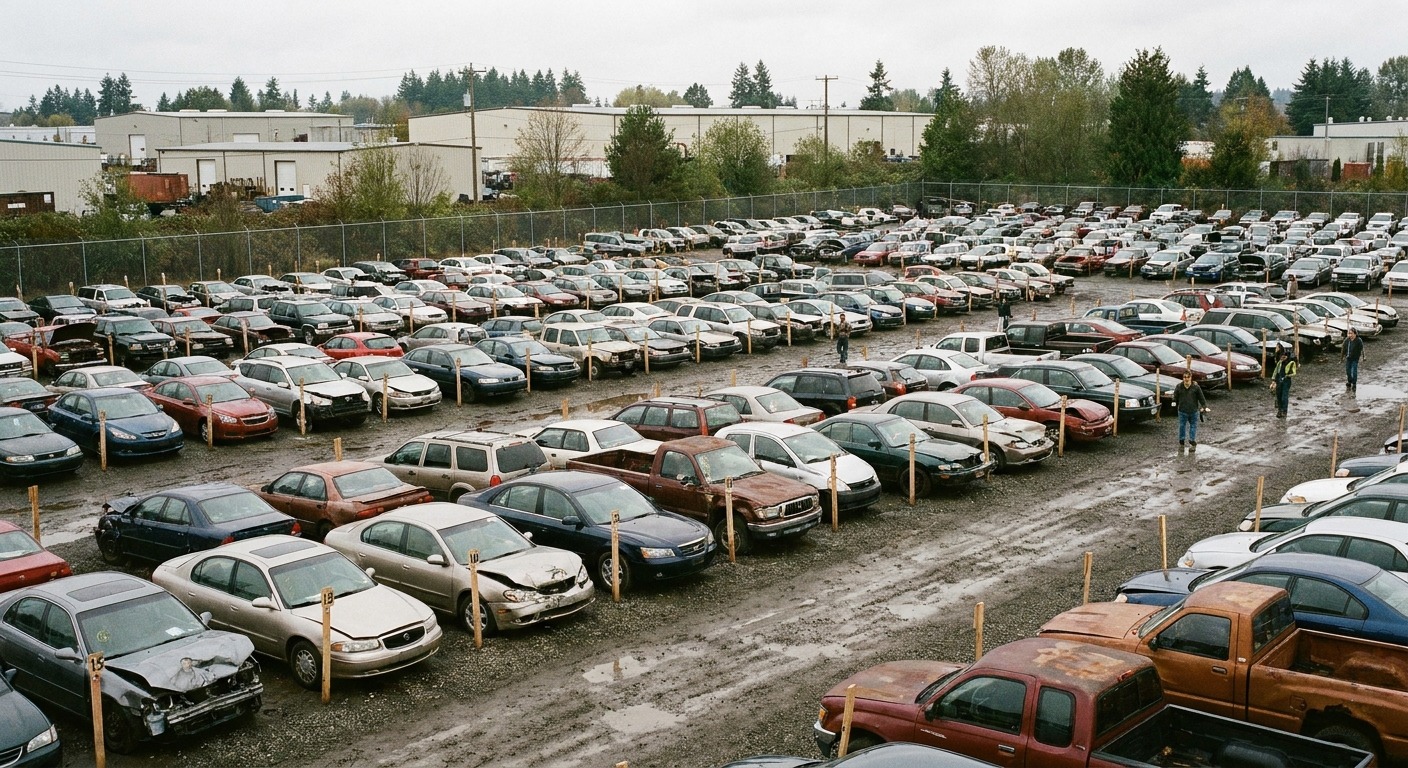
Once a vehicle is declared a total loss, the insurer takes ownership of the wreck (assuming the policyholder accepts the settlement). What happens next follows a predictable chain:
- Title branding: The provincial registry brands the vehicle's title as salvage, irreparable, or a similar designation depending on jurisdiction
- Salvage auction consignment: The insurer sends the vehicle to a salvage auction platform — the two dominant players in Canada are IAA (Insurance Auto Auctions) and Copart, both operating yards across the country
- Bidding: Licensed auto recyclers, rebuilders, exporters, and in some provinces individual buyers bid on the vehicles. Professional yards typically bid based on parts value estimates and current metal prices
- Transport: The winning bidder arranges transport to their facility
- Processing: At the yard, the vehicle enters a systematic depollution and dismantling process
Some larger insurance companies also sell directly to established recyclers through negotiated contracts, bypassing the auction system for consistent volume. And some yards purchase vehicles directly from the public — people whose cars have been written off but who retained ownership, or vehicles that aged out of service without an insurance claim involved.
Salvage Titles: Rebuilt vs Parts-Only
Not all write-offs are equal in the eyes of provincial registries. The title branding system creates critical distinctions that determine what can happen with a vehicle after it leaves the insurer's hands.
- Salvage (Rebuildable)
- The vehicle sustained significant damage but is structurally repairable. It can potentially be rebuilt, inspected, and returned to the road with a "rebuilt" title brand. This is common for vehicles with moderate collision damage.
- Irreparable / Non-Repairable / Parts Only
- The vehicle has structural damage, flood damage, or other conditions that make it unsafe or impractical to return to road use. It can only be used for parts recovery and material recycling. It cannot legally be rebuilt for road registration in Canada.
The distinction matters enormously. A rebuildable salvage vehicle has higher auction value because a rebuilder can invest in repair, pass a provincial safety inspection, and sell it as a used vehicle with a rebuilt title. A parts-only vehicle is worth its component parts and scrap metal value — still significant, but less than a rebuildable unit.
The criteria for which category a vehicle falls into vary by province. This is one of the many areas where provincial differences in end-of-life vehicle rules create a patchwork system. A vehicle branded irreparable in Ontario might have been branded rebuildable in Alberta, where the criteria differ.
What Happens at the Yard
When a salvage vehicle arrives at a professional auto recycling facility, it enters a multi-stage process that has been refined over decades. The sequence matters — both for environmental compliance and for maximizing the recovery value.
The first priority is always depollution: removing all hazardous fluids and materials. Engine oil, transmission fluid, coolant, brake fluid, power steering fluid, refrigerant, fuel, and washer fluid are all extracted and either recycled or disposed of through licensed waste management streams. Mercury switches in older vehicles are removed. Airbags are deployed or removed for proper handling. Batteries are pulled for lead-acid recycling.
Only after depollution does parts dismantling begin. Technicians — many of them former mechanics — evaluate which components have resale value, remove them systematically, test or inspect them, assign condition grades, and enter them into inventory management systems that are networked nationally.
After all saleable parts are removed, the remaining hulk goes to a metal shredder. The shredder breaks it down into ferrous metal, non-ferrous metals (aluminum, copper, zinc), and shredder residue. The metals go to smelters. The residue — the only true waste stream — is typically 5–15% of the vehicle's original weight. Compare that with almost any other consumer product recycling program in Canada and the efficiency gap is staggering.
The Economics Nobody Talks About
Insurance companies are not sending vehicles to salvage out of environmental goodwill. They do it because the salvage value is a direct offset against claim costs. When an insurer pays out $15,000 on a total loss and then recovers $3,000 to $5,000 selling the wreck at auction, that recovery keeps premiums slightly lower for all policyholders.
The auto recycling industry is the buyer that makes that recovery possible. Without yards bidding on wrecks, insurers would face disposal costs instead of recovery revenue. Every written-off vehicle would be a pure expense — towing, storage, and disposal fees — rather than a recoverable asset. The downstream effect on insurance premiums would be measurable.
This is one of the reasons salvage yards keep repair costs down in ways that extend well beyond just the parts they sell. They are a pressure valve in the entire automotive cost ecosystem, absorbing vehicles that would otherwise be pure liability and converting them into economic and material value.
"People ask where their car goes after a write-off like it just vanishes. It doesn't vanish. It gets taken apart by professionals, and its parts go into other cars that are still on the road. The metal gets melted down and made into new steel. Almost nothing is wasted." — Alberta auto recycler
Why This System Matters
Half a million vehicles a year is not a small number. If those vehicles were simply landfilled — which is what happens in countries without a mature auto recycling sector — Canada would be burying over 750,000 tonnes of steel, aluminum, copper, rubber, and glass every year, along with millions of litres of hazardous fluids.
Instead, the vast majority of that material re-enters the economy. The steel recycling loop alone saves enormous energy and emissions compared to virgin mining. Parts reuse keeps vehicles on the road that would otherwise be scrapped prematurely because repairs were unaffordable. The entire system — from insurance write-off to salvage auction to yard processing — is a circular economy operating at scale, largely without government subsidy, driven by market economics.
The next time someone dismisses auto wrecking as a dirty business, consider that it processes half a million vehicles annually with higher recovery rates than any curbside recycling program in the country. The infrastructure exists. The economics work. The environmental performance is documented. What it lacks is the public understanding it deserves — and the regulatory consistency that would make it work even better. That regulatory landscape is something we cover in detail in our piece on what actually governs the Canadian auto recycling industry.